

The Spanish Coast Still Waiting to Be Discovered
For decades, international buyers looking for a home on Spain's Mediterranean coast have tended to gravitate towards the same familiar destinations. The Costa del Sol and Costa Blanca have developed enormous international property markets, supported by airports, golf courses, international schools, restaurants, marinas and a seemingly endless supply of residential developments.
But there is a problem: much of the best land has already been developed, and property in the most desirable locations has become considerably more expensive.
Travel east along the Andalusian coast, however, and the picture changes dramatically.
Almería remains one of the least developed stretches of Mediterranean Spain. It is drier, more rugged and considerably more barren than Málaga or Alicante. But it also has something increasingly difficult to find elsewhere on the Spanish coast: space.
Could that make Almería one of the next major areas for residential development in Spain?
A very different Mediterranean landscape
Anyone expecting Almería to look like Marbella will be disappointed.
Much of the province has an unmistakably semi-desert landscape. Mountains descend towards an often stark coastline, rainfall is exceptionally low and large areas remain almost completely undeveloped.
That landscape is one of the reasons Almería has never developed the same international resort infrastructure as the Costa del Sol or Costa Blanca.
There are golf courses, including Playa Serena, Alborán Golf, Valle del Este and the distinctive Desert Springs, but nothing approaching the concentration of courses found around Marbella, Mijas or Orihuela Costa.
Nor is there the same density of international restaurants, shopping centres, private schools, beach clubs and established expatriate communities.
For some buyers, that will remain a disadvantage.
For others, it could increasingly become the attraction.
The commodity Spain is running out of: coastal land
The international property market along Spain's established costas has changed substantially.
First-line plots have become exceptionally valuable. New developments with genuine sea views increasingly command premium prices, while finding sizeable plots close to the Mediterranean in established areas is becoming increasingly difficult.
Almería is different.
Large parts of its coastline remain comparatively sparsely developed. There are locations where the combination of available land, proximity to the sea and relatively low development density would be almost impossible to replicate today in the most established parts of the Costa Blanca or Costa del Sol.
That creates an interesting opportunity for developers.
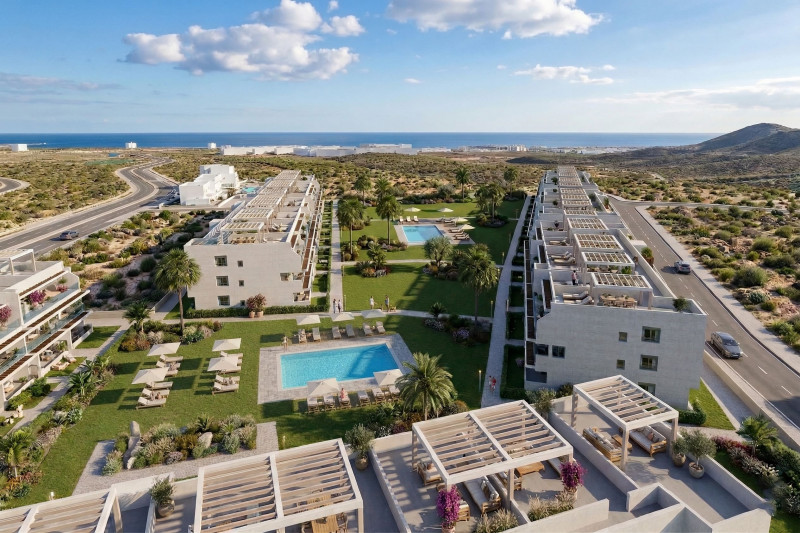
Almería does not necessarily need to recreate Marbella. Instead, its opportunity could lie in delivering something that is becoming increasingly scarce elsewhere: modern Mediterranean property close to the beach, with open views and space around it, at a price that remains accessible to a much broader market.
There are already indications that developers are paying attention. In Pulpí, Metrovacesa recently began construction of Swing Golf, a €10.4 million development of 54 homes close to Mundo Aguilón Golf and the Mediterranean.
This is unlikely to be the last.
Infrastructure could change the equation
Almería's relative isolation has historically been another major disadvantage.
That too is beginning to change.
Work is progressing on the Murcia–Almería high-speed railway as part of the Mediterranean Corridor, with investment in the new line running into billions of euros. Major railway integration works are also transforming access into Almería itself.
The effect should eventually be much greater connectivity between Almería, Murcia and the rest of Spain's Mediterranean axis.
At the same time, Almería city itself is undergoing significant change. Planning initiatives approved in 2026 are enabling land for almost 2,000 additional homes across different sectors of the city, while the long-awaited Puerto-Ciudad project has begun opening the historic centre towards the waterfront.
These are not the characteristics of a province standing still.
And then there is Almería itself
Perhaps the most overlooked part of the argument is the provincial capital.
Almería is not a purpose-built resort town. It is a genuine Spanish city, and that gives it a character that can be difficult to find in some of Spain's most international coastal destinations.
Its historic centre sits beneath the imposing Alcazaba, while traditional tapas bars coexist with an increasingly interesting restaurant scene. The city's gastronomy combines the produce of one of Europe's most important agricultural regions with Mediterranean seafood and a deeply rooted tapas culture.
And then there is the beach.
Almería has an enormous urban beach running alongside the city, allowing residents to combine everyday Spanish city life with the Mediterranean in a way surprisingly few international buyers currently consider.
The wider province adds another dimension altogether. Cabo de Gata offers some of mainland Spain's most dramatic and unspoilt coastal landscapes, while Mojácar, Vera, Roquetas de Mar and San Juan de los Terreros already demonstrate that international demand exists.
Could Almería become another Costa del Sol?
Probably not, and that may be missing the point.
The Costa del Sol has spent decades developing an extraordinary ecosystem around international property, tourism, golf and luxury hospitality. Marbella's appeal cannot simply be reproduced by constructing apartments somewhere else.
Almería also faces genuine limitations. Its arid landscape will not appeal to everybody. Resort infrastructure remains relatively limited, some coastal areas feel isolated and water availability will inevitably influence how extensively certain forms of development can expand.
But property markets do not develop in isolation.
As prices rise in Málaga and Alicante, buyers who once expected a new apartment with a sea view for €250,000 or €300,000 are increasingly being asked either to increase their budgets substantially or compromise on location.
That creates an opening.
If developers can offer attractive architecture, swimming pools, landscaped communal areas and genuine proximity to the Mediterranean at substantially lower prices, buyers may become much more willing to look beyond the traditional destinations.
Spain's next development frontier?
Almería today arguably has some similarities with parts of the Costa Blanca several decades ago: abundant land, extraordinary weather, a long Mediterranean coastline and prices substantially below Spain's most internationally established coastal markets.
It would be a mistake to assume that development alone will turn the province into another Alicante or Málaga.
But it would be equally surprising if developers ignored such a large stretch of Mediterranean coastline indefinitely.
With infrastructure improving, residential development increasing and affordability deteriorating rapidly elsewhere, the economic argument for Almería is becoming considerably stronger.
The question may therefore no longer be whether Almería will see more development — but how quickly international buyers will discover it.


