

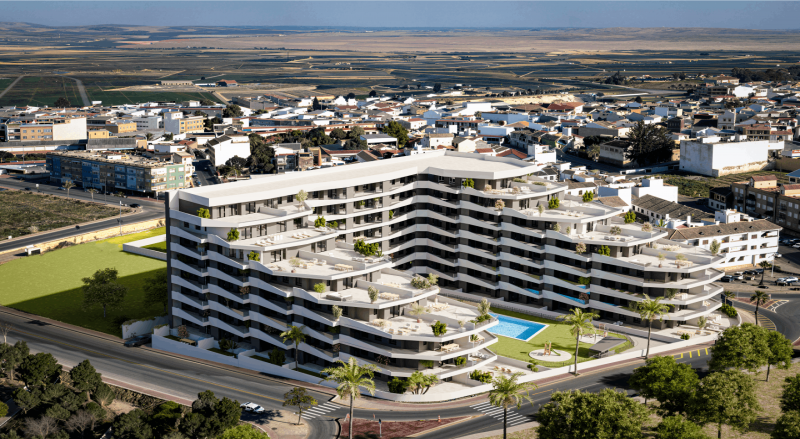
Upward pressure on prices means chances at under €200k are few and far between
For years, the Costa Blanca built much of its international property market around a simple proposition: sunshine, Mediterranean lifestyle and modern homes at prices that looked remarkably affordable compared with much of northern Europe.
That proposition still exists, but the numbers are changing.
Buyers searching for new-build property in 2026 are increasingly discovering that the €150,000–€200,000 apartment that was once relatively easy to find near the coast is becoming the exception rather than the rule.
This is not simply a case of developers deciding to charge more. Behind the rise in new-build prices is a much more complicated combination of land availability, construction costs, labour shortages, planning delays and continued demand.
And on the Costa Blanca, where international demand remains particularly strong, those pressures are increasingly visible.
Demand for the coast remains strong
The first part of the equation is relatively straightforward: people still want to buy here.
According to figures reported by donpiso, interest in coastal property across Spain increased by around 30% during summer 2026, with the Costa Blanca recording a 28% increase in demand.
The profile of that demand has also become increasingly international.
Developers operating on the Mediterranean coast are no longer dependent on one or two traditional foreign markets. Pablo Serna, CEO of Alicante-based developer TM Grupo Inmobiliario, recently said international purchasers account for around 80% of the company's sales, drawn from 36 countries, with Poland currently its largest foreign market followed by the Netherlands, Germany, Belgium and the UK.
This diversification matters.
If demand depended overwhelmingly on one country, an economic slowdown or currency movement in that market could dramatically affect sales. Instead, the Costa Blanca is increasingly drawing buyers from across Europe.
The problem is that housing supply cannot necessarily respond at the same speed.
The Costa Blanca doesn't simply need more land
It is tempting to think that Spain has plenty of undeveloped land and therefore developers can simply build more homes when prices rise.
The reality is considerably more complicated.
What developers need is not merely land, but land that can actually be developed within a reasonable timeframe.
Serna describes the shortage of development-ready land as one of the principal constraints facing the Valencian property market. Spain may have plenty of physical land, but converting it into plots on which housing can legally and practically be built is a lengthy process.
The national competition regulator, the CNMC, reached a similar conclusion in a 2026 study of Spain's planning system. It identified complex regulation, administrative delays and legal uncertainty as barriers to expanding housing supply, and estimated that land can account for as much as 45% of the final price of a home in some circumstances.
The situation becomes particularly acute in established coastal locations.
Benidorm provides an extraordinary example. In September, the city took a major step towards reactivating the PAU-1 Murtal sector near Poniente, where more than 900,000 m² of land and approximately 2,900 planned homes had been caught in more than two decades of disputes and delays.
That land has become strategically important partly because Benidorm has now used up much of its readily developable land.
Twenty years is an extreme case, but it demonstrates an important point: a piece of land appearing empty does not mean a developer can simply purchase it and start building apartments.
Time has become a development cost
Once a developer has secured land, the next challenge is navigating the planning and licensing process.
And time costs money.
A developer may have already paid for the land, architects, engineers and professional services long before construction begins. Capital remains tied up while the project waits for permissions, and financing and operating costs continue.
TM's Pablo Serna recently estimated that each month of delay in obtaining residential licences can translate into approximately a 1% increase in the eventual cost of housing.
Whether every project experiences precisely that increase will naturally depend on its financing and cost structure, but the underlying principle is difficult to dispute: delays are not free.
The wider Spanish construction industry is making the same argument. Representatives of construction and development associations told Congress this month that some urban planning processes can take as long as ten years, identifying land and planning as major bottlenecks to new supply.
Ultimately, somebody has to absorb those costs.
And eventually they work their way into the price of the finished property.
Building costs themselves have increased
Even when a developer has a fully viable plot and permission to build, another problem begins: actually constructing the building.
Direct residential construction costs increased by 5.46% during 2025, according to ACR's construction cost index. Labour costs were identified as an important contributor to that increase.
The days when developers could assume that construction costs would remain broadly predictable throughout a project's planning cycle have become much harder to rely upon.
Materials have increased in price, technical standards continue to evolve, and modern buyers increasingly expect features such as efficient climate control, better insulation, high-quality communal areas, pools, landscaped areas and improved energy performance.
All of those things cost money.
But perhaps the more structural issue is the people required to build them.
Spain has a construction labour problem
Spain's construction industry is struggling to find skilled workers.
Bricklayers, electricians, plumbers, carpenters, experienced site managers and other skilled trades are increasingly difficult to recruit.
According to 2026 data from Spain's public employment service, SEPE, almost 80% of construction vacancies are considered difficult to fill, while 18.6% remain permanently unfilled because suitable candidates cannot be found.
At the same time, a significant proportion of Spain's experienced construction workforce is approaching retirement without enough younger workers entering the industry to replace them.
This creates two problems for housing development.
Projects can take longer to build, and the labour required to build them becomes more expensive.
Both ultimately affect the price paid by the buyer.
The €200,000 question
This brings us to perhaps the most visible consequence for international buyers.
What happened to the €200,000 new-build apartment?
It hasn't disappeared entirely.
There are still locations on the Costa Blanca where new homes can be found below this level, particularly smaller apartments, inland developments and projects in areas where land remains relatively affordable.
But delivering an attractive new home near the Mediterranean for less than €200,000 is becoming increasingly difficult.
For context, Taylor Wimpey España is currently marketing two-bedroom apartments at Eden Beach in La Mata, Torrevieja, from €330,000. The development is around 700 metres from La Mata Beach and includes terraces and communal facilities.
That doesn't mean every new apartment in Torrevieja suddenly costs €330,000.
Central Torrevieja still offers compact new-build apartments considerably below that level, while moving inland or towards other parts of the southern Costa Blanca can reduce prices further.
The important change is that sub-€200,000 new build is becoming a specific segment rather than the default entry point to the market.
Why developers can't simply build cheaper homes
One of the more uncomfortable realities of the current market is that even developers themselves are questioning whether certain affordable housing can be built economically.
Taylor Wimpey Spain has highlighted the difficulties surrounding protected housing requirements on some development land. The company says that plots which appeared financially viable only a few years ago can now be difficult to develop at regulated prices because construction costs have moved so significantly.
This illustrates the problem particularly well.
A developer starts with the eventual selling price and works backwards.
From that price must come the land, construction, architects, engineers, licences, guarantees, insurance, financing, taxes and fees, marketing and sales costs, infrastructure contributions and an adequate margin for assuming the development risk.
If land costs rise while construction costs and financing costs also rise, there is only so far the final selling price can be compressed.
At some point, the project simply doesn't get built.
Does this mean new-build prices can only go up?
No.
Property markets rarely work that neatly.
Individual developments can be overpriced. Developers can misjudge demand. Certain locations can become oversupplied. Economic conditions can weaken. Buyers can become more price-sensitive.
And an expensive development is not automatically a good investment simply because building new housing has become more difficult.
In fact, the opposite argument can be made.
As prices rise, project selection becomes more important.
If two developments cost €300,000, but one occupies a genuinely scarce location with strong demand while the other sits in an area where thousands of similar homes could eventually be built, their long-term prospects may be very different.
Likewise, paying a premium for excellent orientation, views, walkability, build quality or an exceptional location can make sense.
Paying a premium simply because a developer has chosen an optimistic price does not.
What should buyers look at in 2026?
The days when buyers could look only at the headline price are increasingly behind us.
We believe new-build purchasers should understand why a particular property costs what it does.
That means examining the micro-location rather than simply the municipality; comparing price per square metre with competing developments and completed homes; understanding how much future supply is planned nearby; checking the developer's experience and financial strength; and considering orientation, outdoor space, specification, communal facilities and energy efficiency.
Licence status matters too.
A project with land secured, planning resolved and construction underway is fundamentally different from an attractive CGI attached to a development that still faces significant administrative hurdles.
And buyers should distinguish between scarcity and expense.
A changing Costa Blanca
The Costa Blanca remains one of Europe's most accessible Mediterranean property markets, but the economics behind building here are changing.
Demand remains strong. Development-ready coastal land is constrained in many of the most desirable locations. Construction costs have increased. Skilled labour is increasingly difficult to find. And lengthy administrative processes make bringing new supply to market slower and more expensive.
That combination helps explain why the new-build homes reaching the market today often cost considerably more than buyers remember from only a few years ago.
It also explains why the remaining opportunities below €200,000 increasingly tend to involve a compromise: smaller floor areas, locations farther from the coast, earlier-stage areas or municipalities where land remains cheaper.
None of this means buyers should rush into the market because “prices can only go up", that is not true.
But it does mean that waiting for the cost of producing new homes in the Costa Blanca's most desirable locations to simply return to where it was several years ago is unrealistic.
The more useful question for buyers in 2026 is therefore not simply:
“Is this property expensive?”
It is:
“Given the location, land scarcity, specification, competing supply and price of alternatives — does this particular property represent good value?”
That is ultimately the distinction that matters.


