

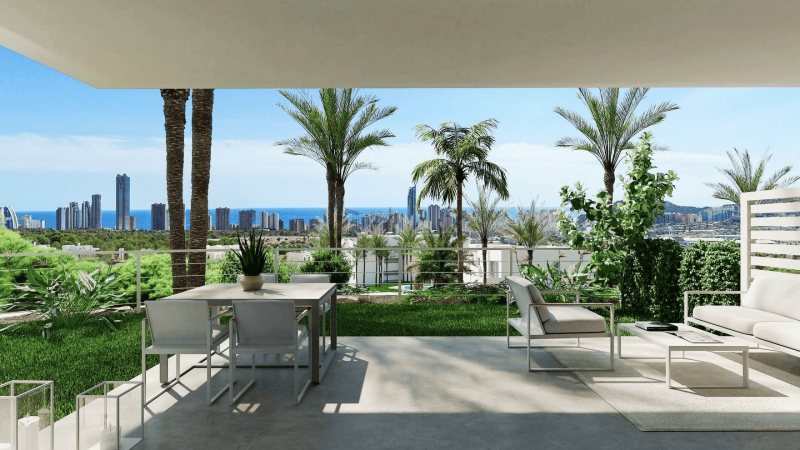
New developments and investment are reshaping perceptions of the southern Costa Blanca
The New Costa Blanca: Why the Gap Between North and South Is Narrowing
For many years, there has been a fairly clear divide on the Costa Blanca.
In the north, towns such as Altea, Jávea, Moraira and Benissa have long been associated with high-end villas, established residential areas and a more international premium property market.
Further south, the picture has traditionally been different. Torrevieja, Orihuela Costa and the surrounding areas have been known primarily for affordable holiday homes, golf, beaches and a large supply of apartments and townhouses.
That difference still exists.
But it is no longer quite as clear-cut as it once was.
A Different Type of Property Is Emerging in the South
One of the clearest changes can be seen in the properties themselves.
New development on the southern Costa Blanca is no longer limited to relatively simple holiday homes close to the beach. Today, there are developments placing much greater emphasis on architecture, design, energy efficiency, communal facilities and homes designed to work just as well for longer stays as they do for a few weeks in the summer.
Las Colinas Golf & Country Club is a clear example of how the market has evolved. Golf, nature, restaurants and services sit alongside contemporary architecture and villas at price levels considerably higher than those traditionally associated with the southern Costa Blanca.
The same development can be seen, in different forms, around La Finca Golf, Finestrat and parts of Orihuela Costa.
This does not mean that the southern Costa Blanca has suddenly become a uniform luxury market. In fact, one of its strengths remains the considerable variety of properties and price points available.
What has changed is the breadth of the upper end of the market.
Torrevieja Is Changing Its Position
Perhaps nowhere is the shift more visible than in Torrevieja.
The city has long had a large international population and an extensive range of everyday services, while at the same time carrying a reputation as a destination associated mainly with lower-cost holiday property and mass tourism.
That is gradually changing.
The redevelopment of the port and the opening of Paseo del Mar have introduced new dining, retail and leisure space directly on the waterfront. At the same time, new residential districts are being planned and developed, with La Hoya the largest example.
This is not about Torrevieja becoming the next Altea or Moraira.
What is more interesting is that the city is beginning to offer something different: a combination of genuine year-round city life, an international population, beaches, services and an increasingly modern residential market.
Infrastructure Is Beginning to Catch Up
Rapid growth on the southern Costa Blanca has not come without problems.
In parts of Orihuela Costa, population growth and residential development have for years moved faster than investment in public infrastructure.
That remains a relevant consideration for anyone looking to buy in the area.
But here too, things are moving.
During 2025 and 2026, Orihuela Town Hall announced and began a number of investments in the coastal part of the municipality, including improvements to roads, water infrastructure and public spaces. A second health centre for Orihuela Costa is also progressing through the planning process, with an estimated investment of close to €10 million.
The municipality has also announced that proceeds from the sale of three municipal plots, with a combined starting value of more than €21.6 million, are to be directed towards investment in Orihuela Costa.
None of this solves every infrastructure challenge overnight.
It does, however, show that greater attention is being paid to infrastructure as the area continues to grow.
Accessibility Remains One of the South's Biggest Strengths
Another important part of the southern Costa Blanca's appeal is Alicante-Elche Miguel Hernández Airport.
The airport handled almost 20 million passengers in 2025, an increase of 8.5 per cent on the previous year, and served 228 routes.
Around 90 per cent of its passenger traffic is international.
For many European property buyers, that matters. A home that is easy to reach throughout the year is considerably easier to use regularly, particularly for people who are still working or dividing their time between two countries.
For much of the southern Costa Blanca, proximity to the airport remains a very practical advantage.
North and South Still Offer Different Things
The development of the southern Costa Blanca does not mean that the differences between north and south are disappearing.
Costa Blanca North has qualities that are difficult to replicate.
Its mountainous landscape, smaller coves, established villa areas and towns such as Altea, Moraira and Jávea have created a property market with a distinct identity and a strong international reputation.
It is also a market that has developed over many years.
The southern Costa Blanca has a different character. The landscape is flatter, the supply of property is larger and the distances between different types of areas are relatively short. Coastal towns, golf resorts, established urbanisations and new developments can all be found within a comparatively compact part of the coastline.
Neither is necessarily better.
They simply offer different ways of living.
What Is Changing Is Perception
Perhaps the biggest shift, therefore, is not about geography or even property prices.
It is about expectations.
A buyer looking for a contemporary villa, good architecture, quality restaurants, golf, fitness and an international day-to-day lifestyle might once have automatically focused on a handful of established locations.
Today, the search area is wider.
The development of places such as Las Colinas, Finestrat, Torrevieja and Orihuela Costa shows that it is becoming increasingly difficult to divide the Costa Blanca neatly into an exclusive north and an affordable south.
There are still significant differences between individual areas, and they should not be underestimated.
But the line between them is becoming less distinct.
For today's property buyer, that ultimately means one thing: there are more places worth considering before deciding where on the Costa Blanca to call home.


