

The Evolution of the Spanish Second Home
For decades, the dream of owning a property in Spain followed a familiar formula. A sunny apartment close to the beach, somewhere to escape for a couple of weeks each summer before returning home.
Many of the coastal developments built during the 1990s and early 2000s reflected exactly that. They were designed for short holidays rather than everyday living. Compact kitchens, limited storage, basic insulation and simple communal areas were perfectly adequate when owners expected to spend only a few weeks a year there.
Fast forward to today, and the international buyer has changed dramatically.
Buyers Are No Longer Shopping for Holidays
Increasingly, buyers are asking themselves a different question.
Rather than asking, "Where shall we spend our holidays?" they are asking, "Could we actually live here?"
For some, that means spending several months each year in Spain. For others it means working remotely from the Mediterranean or planning ahead for retirement. Many younger buyers simply want the flexibility to use their property whenever they choose rather than saving it exclusively for annual holidays.
That subtle shift has transformed what people expect from a property.
A New Generation of Homes
Modern developments are being designed with a very different lifestyle in mind.
Buyers now expect generous open-plan living spaces, larger terraces that become an extension of the home, efficient air conditioning, quality insulation, fibre internet and energy-efficient construction.
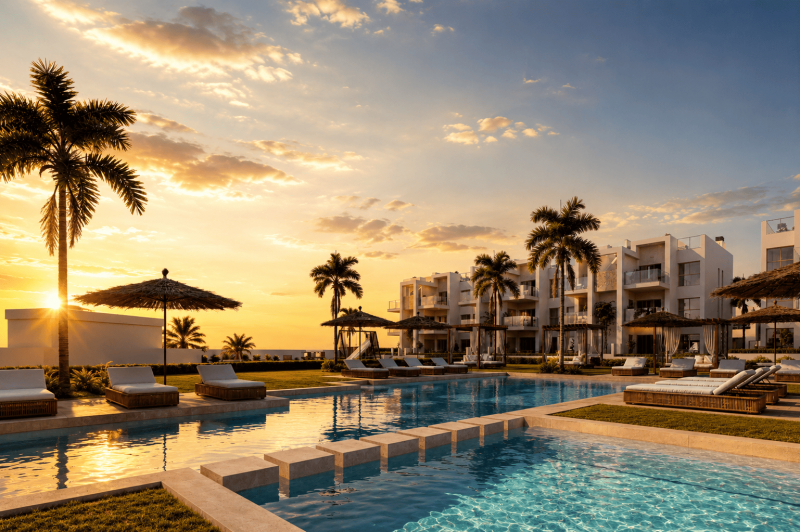
Communal facilities have evolved too. Swimming pools are no longer enough on their own. It is increasingly common to find gyms, wellness areas, coworking spaces, landscaped gardens, children's play areas and even beach clubs becoming part of the overall offering.
Developers are no longer simply selling apartments.
They are creating places where people can comfortably live throughout the year.
Location Means More Than Just Distance to the Beach
Of course, proximity to the sea remains hugely important, but today's buyers are looking beyond that.
They want restaurants that stay open all year, healthcare nearby, supermarkets within walking distance, golf courses, cycling routes, international schools and airports offering easy connections across Europe.
The strongest-performing locations increasingly combine lifestyle with practicality.
Whether it is the established luxury of Las Colinas, the growing appeal of La Finca Golf, exciting regeneration projects around Torrevieja or new communities emerging on both the Costa Blanca and Costa del Sol, buyers are looking for destinations that work in every season rather than just July and August.
Older Doesn't Always Mean Worse...
There are, of course, many beautiful resale properties along the Spanish coast. Character, mature gardens and established neighbourhoods remain incredibly attractive to many buyers.
However, it is also true that a significant proportion of older coastal developments were built for a different era. In many cases, they were designed primarily for seasonal use, at a time when buyers expected fewer modern comforts and construction standards were very different from those we see today.
As international buyers become more discerning, expectations around build quality, energy efficiency, sound insulation and year-round comfort have risen considerably.
That doesn't mean older properties cannot be fantastic homes, but it does explain why many buyers increasingly find themselves comparing not just price, but how well a property fits the way they actually intend to use it.
It's a Lifestyle Decision
Perhaps the biggest change of all is that buying property in Spain has become less about owning a holiday apartment and more about investing in a way of life.
People are choosing where they want to spend time with family, where they might work remotely, where they hope to retire or simply where they feel happiest.
That is why modern developments increasingly focus on creating communities rather than simply constructing buildings.
The holiday home has not disappeared entirely.
It has simply evolved into something much bigger.
For today's buyer, the best property is no longer just somewhere to visit. It is somewhere that genuinely feels like home.


